Tuesday, May 14, 2013

Culture Gate


"si fueris Romae, Romano vivito more; si fueris alibi, vivito sicut ibi" 
St. Ambrose

"When in Rome, do as Romans do."


Criticizing the customs of other cultures may well be the world's second oldest profession. As a 22 year-old, I left the U.S. for the first time heading to Korea, thinking the U.S. was the center of the universe. Apparently, a number of Americans suffer from the same affliction. 

Now, I don't know if Bill Gates thinks the United States is the center of the universe, but he seems to think he is. Wait, stop right there!---you may be thinking. Criticize Bill Gates? He's the world's biggest philanthropist. Cut the guy some slack. I'd love to, if Mr. Gates demonstrated just a modicum of humility.
50 Bill Gates Quotes on Life, Wealth and Leadership
Bill Gates

Recently, Mr. Gates was the guest of Korea's new president, Ms. Park Geun Hye. Demonstrating surprising cross-cultural insensitivity, he greeted the head-of-state with his hand in his pocket. One has to wonder where his advisors were on this one.

Humility, however, might not be Mr. Gates' biggest asset. He allegedly had this to say about his financial status, "I have $100 billion…You realize I could spend $3 million a day, every day, for the next 100 years? And that's if I don't make another dime…" On the other hand, what do you think Mr. Gates' reaction might be to someone coming to his office for an interview requesting a several million dollar donation for their favorite cause wearing torn jeans and a Hawaiian shirt?

South Korean President Park Geun-hye (left) shakes hands with Microsoft founder Bill Gates, from the USA, at the presidential office Cheong Wa Dae in Seoul, South Korea, 22 April 2013. -EPA
Oops! Should have taken humility training 
If you are here in Korea for any length of time, you would be privy to some foreigners' long lists of issues and gripes with Korean culture. These range from the food, to driving habits, to the disposal of garbage, to education practices, to alcohol consumption customs, and everything in between. Truth-be-told, I get stoked when I stand at a stop sign and never, ever see a Korean driver come to a full stop. Nope, ain't goin' to happen here. I have my strong bias, but it is not my country.

When Koreans come to the U.S. and slip into the driver's seat, there will be some pretty serious consequences for not stopping at stop signs. I suspect that after a few moving violations, or worse, an accident or two, the new cultural context will be quickly assimilated; proving yet again St. Ambrose's theory.

Mr. Gates, who waxes at length about global awareness gave this advice recently, "I do think this next century, hopefully, will be about a more global view. Where you don't just think, 'Yes, my country is doing well,' but you think about the world at large." Yes, Mr. Gates, when you prepare for your next global encounter, the recipe calls for two ounces of preparation, one dollop of humility. And please sir, stir with both hands.

Saturday, May 4, 2013

Searching For Mr. Good Job

The Hong Man Statue on the campus of Yeungnam
University. He has a lot on his mind

He looks vaguely disconcerned, carrying the load of a weighty problem instead of a heavy backpack, so commonly associated with today's college students. The Hong Man statue (홍만동상) is the university's popular meeting point, near the center of campus and a stone's throw from the library. But he is more. He may be the university's unofficial mascot--an unintended metaphor for the thousands of Korean students who ponder their future after college.

Korea had famously earned the title of Asian Tiger due to its incredible economic growth since the early 1970's. But that growth is cooling. Korean middle class households shrank from 75.4% in 1990 to 67.5% in 2010. Fifty-five percent of middle class families are having a tough time making ends meet as they are increasingly burdened by debt, according to McKinsey. There has been a drop in the number of high paying jobs with major business conglomerates--so idolized here in Korea. From 2002-2010 there has been an average decline of 2% a year in domestic hiring by major manufacturers. And the household savings rate fell from 20% in 1994, to just 3% in 2012--the lowest among the OECD countries.

Korean college students are facing this challenging environment. There are simply not enough good jobs for all the highly educated people entering the economy. More and more young people are being forced to take jobs they are overqualified for.

Here are snapshots of seven Yeungnam University college students who are pondering their future. These students shared their perspectives in English, speaking in a second language. Six are undergraduate students serving as volunteers at the university's Foreign Language Institute. One is a graduate student working as a staff assistant.  I asked each of them the following question: What is the most important thing on your mind these days?

Here are their stories...

Park Min Jin, 25: "When I write,  I'm happy"
Park Min Jin is bright and thoughtful. A senior, she is majoring in English Literature, with a minor in International Trade. For Min Jin, the most important thing on her mind, reflecting the recent tensions here on the Korean peninsula, is the conflict between North and South Korea. "I am thinking about a possible Korean war," she said. Referring to North Korea's young new president Kim Jung Un, she added, "Kim is too young and he may do something stupid. His father and grandfather had experience--they were able to control their people." Living near a U.S. military base in Daegu has Min Jin worried.


The second most important thing on her mind involves a dilemma about her career. "I am thinking about my dream. I love writing and meeting new people and I love hearing their stories. My parents don't want me to be a writer. They want me to use my English speaking skills at a big Korean company, like Samsung." This challenge, of navigating toward one's personal dream, in a world of strong and conflicting parental preferences, is reflected in the stories of many students who are about to enter Korea's job market.

Cheong Young Yuk: "Here in Korea most people will judge
your success by what car you drive, your house, and what
area you live in"
Cheong Young Yuk, a senior, was quick to respond when asked what was on his mind these days. "I want to do something, but I can't," he said. "I want to get into martial arts or have a pub." I asked him why he said this wouldn't be possible. "These two ideas could only be hobbies, not a real job," he responded. "My dream is small. I want to be happy. My dream is having a family with three children. But, I will need a lot of money. I need to be able to support them. A job is one option to realize that dream."

Young Yuk explained his situation, "Everyone forces me to have a job--parents, professors, friends. The only thing they seem to ask about is jobs. 'What company?' 'How is your studying going?'" Said Young Yuk, "I have to think about it. I have to think about it all the time."

Kim Ji Hyun, 25: "I will follow my own path"
Kim Ji Hyun is a first year graduate student pursuing a master's degree in English Education. Being a graduate assistant in the Foreign Language Institute and working with foreign language professors, informs what is on her mind these days. "This job allows me to have many experiences that are helpful to my major. I really enjoy the English that is all around me." Says Ji Hyun, "I am happy to speak with and meet foreign professors and to practice my English. My experiences here will help my future English students."

But an important test awaits Ji Hyun. This too is on her mind these days. "After graduation, I want to be an English teacher. So, I have to take the Teachers' Qualification Exam. Thinking about that future exam makes me nervous. If I don't pass the exam, I will need to find another job--possibly needing to go abroad to teach Korean to foreign learners." Then Ji Hyun added, "My parents are worried about my marriage plans because of my age. There is pressure from them to pass the exam at once and to think about my age and marriage." Like many of her fellow students, parental pressure plays a role in her future plans. But, added Ji Hyun, "I am not worrying about this. To me, it doesn't matter what age I will be when I get married. It could be 25, 30, 35 or 40. I will follow my own path."

Kim Young Kyung, 26: "My age is not really young for
getting a job in Korea. Most companies prefer people in
their early 20's"
Kim Young Kyung, a senior completing her last semester at Yeungnam University, is majoring in English Literature and Language and minoring in Media and Communications. What's on Ms. Kim's mind these days? "Thinking about my job after graduating. I want to be a news anchor broadcasting the news. That job," says Young Kyung," is very competitive in Korea." Without missing a beat, she added, "My parents want me to work for a large company--to get a stable job with a high salary."

Young Kyung also finds that she is spending a lot of time thinking about relationships. "Meeting with people when I was younger was easier," she said. "The older I get, the harder it is to get to know others--to get the closeness of high school and middle school friendships." But other kinds of relationships occupy her thoughts as well. "I am also thinking about boyfriends and marriage. As a freshman, I was interested in my friends, not in dating. Now," she says, "most of my friends have boyfriends, so I am thinking a lot about boyfriends and marriage--what kind of person will I meet?"

Bae Su Hyun, 25: "My parents have supported me for
25 years, so I need to support myself from now on"
What's on the mind of junior Bae Su Hyun? It's all about putting the pieces in place for a future job. "I need some more certifications, for example in computers, Korean history, Korean language and Chinese characters and," he continued, "to improve my grades." His GPA is now 3.9. He says he needs to push it up to 4.1.

But there is more, much more, to Su Hyun's career preparation plans. To be a stronger candidate he believes that he needs to get more volunteer activities under his belt. "I need to do volunteer work to support someone else's organization, for example, in the area of fundraising," says Su Hyun."Here in Korea big corporations have their own favorite charities. I need to do something so that I have something to tell them when I have a job interview. I always find myself thinking about this; how can I describe this kind of experience on a job interview?"

There was yet another matter on Su Hyun's mind these days--the conflict here on the Korean peninsula. "I am thinking about the Korean conflict. This is true for many of my friends and me. It is a common thing for us." He continues, "When I read the articles in the New York Times and hear other news from abroad, it looks really serious. Japan said if North Korea is going to start a war, then Japan will attack first. I think that would be really terrible. If Japan attacks our peninsula first, it is going to be hell."


Seo Yeon Jeong (Olivia), 24: "I want to join a cosmetics
company. I want a job in international marketing"
Majoring in English language and literature, with a minor in media and communication, Seo Yeon Jeong, said "getting a job after graduation," was the most important thing on her mind these days. Olivia (her English name) added a touch of both pragmatism and philosophy to our conversation. On the practical side, she noted that she is "currently taking a job search strategy course," adding "I am told you need a lot of skills" for a potential role in international marketing in the cosmetics industry that she aspires to. "Also key, is the university's reputation," she added. But Olivia has also been thinking about human relations. "Dealing with people is the hardest part of life,"she said. She has been reflecting on her relations with both family and friends. "Be slow and careful in judging people," Olivia noted. That sounded like sage advice indeed.

Lee Jin Kyung: "Students are under a lot of pressure here."
Where does the pressure come from? "From society"
Lee Jin Kyung, now a senior, took a year off from Yeungnam University to study English in Toronto, Canada. "It was really a good experience," she noted. "I made many friends from many different countries." She did volunteer work while living in Toronto. "It was the happiest time in my life." She summarized her multi-cultural experience there by adding, "I became friends with a French person, a Japanese person and lived with a gay guy in a homestay."

When asked about what is currently on her mind, Jin Kyung said, "The most important thing on my mind these days is finding a suitable job. I am searching for marketing and accounting jobs." And she added, "I don't yet know what fits me."

Another matter on her mind is her final year at Yeungnam University. "I am trying to make this last year of my schooling a beautiful year for me. I am trying to meet many friends and create good memories." With Cherry Blossoms the focus of many peoples' attention recently, Jin Kyung was a bit reflective, "For me, the Cherry Blossoms bring sadness because I know this is my last year here."

There is a rumor amongst students here at the university. It goes something like this: Hong Man (he of the statue) is sad. He is depressed. He has the weight of the world on his shoulders. Hong Man is like many of the students about to graduate from Yeungnam University. They have studied hard and diligently for many years. They have hopes and dreams. There are many things expected of them, by many people.

These Korean students, and perhaps thousands more, are searching for Mr. Good Job. One wonders how many will find him.


Sunday, March 24, 2013

From Korea, With Much Appreciation


Many years ago, soon after arriving in Korea for the first time, my good friend, Soon Chul, made a suggestion that I have long since taken to heart. I could do something simple but important, he said, to show Koreans that I both understood and respected their culture. "Steve, when someone does something for you, if you get good service in a restaurant,” for example, he said, “tell that person that you appreciate them, say Sugo-ha-shush-simneeda." (in Korean, 수고하셨습니다).

I wasted no time putting my new expression to good use. I used it in restaurants, when my Korean teachers taught me a lesson that was helpful, or when a person at some government office or bank provided me with good service. You get the idea. I can say, without exaggeration, that in return, I’ve received an appreciative smile more than 95% of the time.

Importantly, in the Korean culture, and in most of Asia, tipping is not customary. For me, this took some getting used to. In the States for example, if you told your waitperson that you both appreciated the food and service, and then proceeded not to leave a tip, you generally would be looked at with daggers. Most restaurant wait staff expect a tip equal to 15-20% of the bill--even more with large parties. Here in Korea, a customer never leaves a monetary tip. Tourists and recent expats are often gently reproached when they unknowingly do so.


Saying "we appreciate your hard work," in Korean, always induces a smile


While Sugo-ha-shush-simneeda is used often and most Koreans don't place existential meaning in it, it is nevertheless, expressed genuinely and sometimes from the heart. The person providing the service is reminded that they have done a good job in the customer's eyes—that they have worked hard--and that you recognize and appreciate their efforts.

These days I have to remind my Korean friends traveling to the U.S. or Canada that leaving a tip is expected. They may not fully understand that waitpeople, at least in the States, are often paid less than the local minimum wage. These hard working folks rely on tips as the mainstay of their income. Simply saying "thanks" and "we're appreciative of your efforts" won't pay the daycare or heating bills.

Meanwhile, back here in Korea, if a foreigner unwittingly leaves a tip on a restaurant table for the waiter or waitress, they are likely to soon encounter the person running down the street after them. "Excuse me, you left your money behind," is likely to be the refrain. 

My old friend was right. Those few words have held a world of meaning for me. While my pronunciation may be off a bit, the meaning is never lost on Koreans.

Friday, March 15, 2013

Keeping the Door Open


Unlike the United States, Korea has to import every ounce of its fossil fuel needs. During this past winter there was a national initiative requiring all universities to turn off their heating from 10 AM through 1 PM to reduce fuel consumption and save the country precious dollars.

Other than a rare sighting in the fanciest of department stores, you will not see a dryer in this country. Do the math--that’s hundreds of thousands of apartment units in which the builders provide a washing machine--but no dryer. Instead, you’ll find drying racks attached to the ceilings of apartment balconies that pull up and down with a cord, like venetian blinds.
Apartments, apartments everywhere, but not a dryer to be had
Why pray-tell, are dryers extinct in Korea? Any Korean will tell you: they use far too much power, especially for a country counting fossil fuel pennies (more on this later). This may, at first, surprise the average non-Korean reader. Dryers alone, excluding their own purchase price, account for 12% of the total electrical use in a typical household. That’s $200 a year. According to Mr. Electricity, “Dryers are unnecessary in the first place since you can just hang your clothes up to dry. There’s a 100% savings to be realized here.” Koreans may be on to something. Maybe.

Our dryer
One of my favorite roles as an English professor here is sitting down one-on-one with students. My university has a great program which matches interested students and faculty in sit down weekly sessions to discuss almost anything in pursuit of the quest of helping students improve their English. I love these meetings. I tell my one-on-one students to come prepared to talk about any topic they’re interested in. Last year, Honey wanted to talk about why she failed her driving test. Chris wanted to discuss the forthcoming Korean presidential elections. John, an economics major, wanted to talk about farming techniques that might help the Korean economy. “Fine.” I said. “But when we're finished, please allow me to ask you a few economic questions." He looked at me both curiously and expectantly.  

Soon we were discussing a major paradox for me. "Why, during the coldest winter months, do many Korean institutions keep their front doors wide open? And why, in Korea, do you find many windows in hallways, and even rooms, open when it’s freezing outside?"

There are a number of possible interpretations here. For example, many are based on the old Korean belief that opening doors and windows allows germs to be whisked out of the home. But why then shut down the country’s heating systems for weeks on end, morning until afternoon to save money, while doors and windows are open everywhere?

John came back to our next session agreeing that there might be a huge cost-savings opportunity for Korea here. I made some notes and gave John a few suggestions for improving his English—the real purpose of our sessions.

It is of course one thing for a university to ask the staff to turn their computers off at the end of the workday as part of an energy savings initiative. It is quite another to attempt to change the wider-culture hell bent on keeping their country germ-free. But you’ll find me, nevertheless, closing every open door and window in Korea. Really Steve?

Back to my Saturday morning. The washing machine buzzes. It’s time to hang my clothes on the drying rack. As I release the cord and lower the rack, I’m reminded that living and being in another culture is a privilege—especially if you keep the door open.


Thursday, February 28, 2013

Teach At A Daegu "U"


“A good command of English is vital to be successful in Korea’s job market”
Lee Byeong Wan, Ph.D., Professor, Economist, and former Director of Yeungnam University’s Foreign Language Institute

There are more than 27,000 native English speakers currently teaching in Korea, helping to fulfill a remarkable national strategy for learning English. The largest contingents are from the U.S., Canada, the UK, Ireland, Australia, New Zealand and South Africa. That figure is even more impressive when you consider that as recently as 2002, there were 10,950 English speakers teaching in Korea—less than half the current number.

Video screen near Yeungnam University Maine Gate
English teachers can be found in all types of teaching venues and roles in Korea, with the single largest contingent working at private English Centers known as Hagwons. Many teach at the elementary and secondary levels. Daegu, known as an education center in Korea, has an impressive number of educational institutions. As of 2009 there were 215 elementary schools, 123 middle schools and 91 high schools. There are also more than 20 universities and colleges.  Our focus here will be on native English speakers teaching at the many colleges and universities in Daegu.

What attracts English teachers to roles at universities? According to Lee Byeong Wan, professor and economist at Yeungnam University, the leading factors include:  the opportunity for professional development, the intellectually stimulating environment, longer vacations, and the multiple perspectives that are included in faculty evaluation systems, such as feedback from students, colleagues and staff.
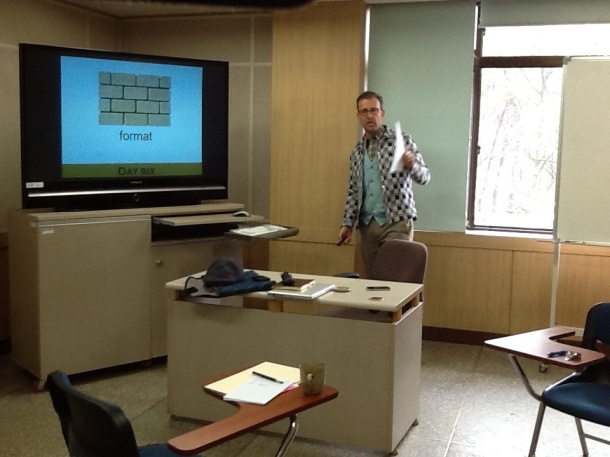
John Teaching
My YU colleague, Professor John H., preparing for what is sure to be a great lesson
Successful English teachers at the university-level tend to demonstrate several attributes. Professor Lee found that the characteristics of effective EFL/ESL instructors include: enthusiasm, preparation and patience. My personal experience bears this out. A significant lack of any of these factors can present problems for a native speaking university instructor or professor.

Over the last several decades there is an unmistakable upward trend in the number of native English speakers teaching in Korea. Factors influencing this trend include: the economic conditions in one's home country; personal interest in a new cross-cultural experience and the salary, benefits and work conditions at the Korean work site. The latter, of course, vary from school to school. But university instructors and professors generally find their compensation to be at the higher end of the English educator salary pay continuum. Workloads, while sometimes challenging, tend to be significantly less than those faced by teachers at Hagwons, elementary, middle or high schools. Professors generally have teaching loads of 12-18 hours/week. Instructors usually teach 17 hours/week or more.
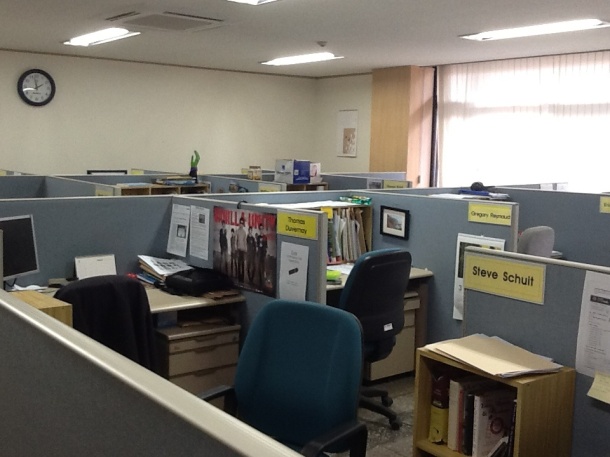
Office
Universities usually ensure that English teachers have comfortable and well-equipped offices. This is a shared office at Yeungnam University
Many college-level teachers have master's degrees and even doctorates. However, there are many individuals teaching English at universities who do not have graduate degrees. Yeungnam University, for example, recently eliminated its previous requirement of a master's degree for a professor’s position--this change is said to provide the university greater flexibility in its recruitment efforts. On the flip-side however, many schools require prior university-level teaching experience from their candidates.

As would be expected, compensation varies widely. One recent survey of 30 Korean universities found that starting annual salaries for university level English teachers with a master's degree was between 35,000,000 – 37,000,000 won. For faculty with a bachelor's degree, the starting salary was 26,700,000 won. In terms of housing support, 37% offered a housing allowance or free housing.
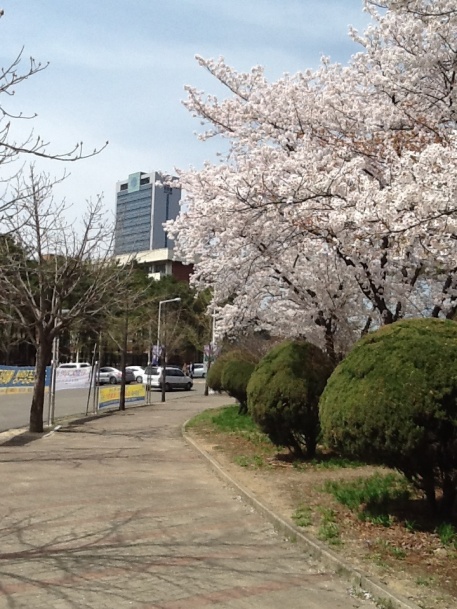
YU Cherry Blossoms
Of course, a university English position usually comes with a campus--often a beautiful one. This is Yeungnam University during April's Cherry Blossom season. YU's campus is nearly 1,000 acres
If you are considering a university-level English teaching position, a good place to start is to speak with someone who is currently in the role. Networking is an important strategy in any job search, and that goes for  teaching English at the university level as well. Use your connections, make contacts through friends and friends of friends, and set up an “informational interview” to learn more about a particular college environment, a school or department’s work and learning climate and what a typical week is like. For example, at Yeungnam University’s Foreign Language Institute, all faculty members are expected to also work several hours a week at the school’s English Help Desk. In addition, staff members have the opportunity to coach students one-on-one through a special program sponsored by the Institute.
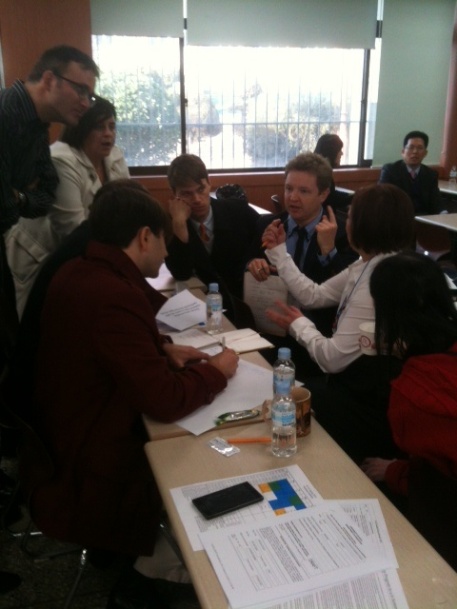
Engaged Faculty
Highly engaged faculty. YU Professors meeting to discuss plans for the spring semester
University job openings can be found on the various university websites. Popular on-line sites include Dave’s ESL Café and ARJK.

Education continues to be an important contributing factor to Korea’s success. And with more than 20 colleges and universities in the Daegu area, the teaching of English is an important economic stimulant to the area's economy. Make your mark, teach at a Daegu “U.”