Tuesday, November 6, 2012

[Nov/Tour] Gatbawi – A Masterpiece of Buddhist Sculpture, Near Daegu


He sits there patiently and stoically. As soon as you cast your eyes upon him you know that your walk up the mountain trail was well worth the effort. Gatbawi, the sitting Buddha, is considered one of the masterpieces of Buddhist sculpture. An official Korean Treasure (No. 431), the 4-meter tall stone Buddha, Gatbawi, was carved in the 9th century. There he rests on a mountain peak, overlooking a wide vista north of Daegu. As the Buddha of medicine, he holds a medicine pot in his left hand. The stone headpiece atop his head represents his supreme wisdom, while the position of his hand symbolizes the expelling of evil. This latter point is important because tradition has it that Gatbawi will grant visitors one wish.
Gatbawi, Korean Treasure no. 431

A trip to Gatbawi is mesmerizing for reasons of your choosing. Perhaps it is seeing the sitting Buddha himself. You might savor the dramatic view of the countryside. For the weekend hiker in you, the trail up to Gatbawi is pleasant, as the long staircase and trail wind and climb through the forest that blankets the mountainside. Your trip to Gatbawi, by any measure, is well worth the visit.

Hiking up the mountain staircase

Give yourself several hours for the visit and climb up.

Getting there: Leaving Dong Daegu Station, exit and turn right, walk down a set of stairs. You will see the city bus stop ahead. Take bus #401, or 101-1 to Gatbawi (40-50 minutes).  By taxi, the trip is 25-30 minutes from Dong Daegu Station (figure a 20,000 won fare).

Sunday, November 4, 2012

Afternoon Delight


In recent years coffee shops have proliferated throughout Korea. Franchised coffee shops, offer predictability and convenience, but they are rarely interesting, creative or welcoming. However, there are a few gems out there that bring delight to coffee lovers in the Daegu area. Cafepresso, thanks to owner-baristas Ho and Miri, is just such an oasis. Roasting and hand-drip experts, they ply their trade with passion and artistry. Taste a delicious fresh brewed Dutch Coffee or a wonderful White Cafe Mocha. Treat yourself to a mouthwatering dish of Vanilla Ice-Cream, drizzled with chocolate syrup and adorned with almonds and oreo cookies. Experience the Honey Bread with fresh cream. Cafepresso gets our vote for best coffee shop in the greater Daegu area. It's well worth visiting.
    Phone: 053-801-6668   Address: 562-5 Sa-Dong Gyeongsan City  Baristas: Ho and Miri

Delicious Coffees and Desserts


Welcome to Cafepresso!

Owner/Baristas Ho (left) and Miri


Cafepresso Location


Tuesday, October 30, 2012

Daegu Boasts Best Thai Food This Side of Bangkok

Ah, savory soups and heavenly dishes. Korea's fourth largest metropolis, Daegu, boasts MK Suki, a magical Thai restaurant that will please anyone yearning for authentic Thai food. One of our dishes (see photo) featured fresh squid, sweet mini-corn cobs, mushrooms and fish in a delicious, light broth. I yearn for more just recalling my recent visit. No problem. MK Suki is an easy find, located across the street from Daewoo Trump Apartments in Daegu's Suseong-gu neighborhood.
    Restaurant: MK Suki (Thai), Address: #998-4 Jisan-dong, Suseong-gu, Phone: 053-783-6400

Culinary art. Seafood dish featuring squid and sweet corn.

Tuesday, October 23, 2012

Guilty Pleasures of an Expat in Daegu

Delicious Duo--Hamburger and Cut Fries 
Burger Project and Chef Choi-The Real Deal
OK, I am guilty as charged. I was in downtown Daegu and saw the tempting photos of hamburgers at Burger Project. Could they be as good as alleged? This is, of course, a man who has not had a real, honest-to-goodness hamburger in some time. Alas, my hamburger was off-the-charts delicious! Moreover, the cut potatoes were unbelievably mouthwatering. Ah, the guilty pleasures of an expat in Daegu. Come meet Chef Choi at Burger Project in the Hyundai Department Store in downtown Daegu.


Thursday, October 4, 2012

The End of the Line


"Well, it's all right, riding around in the breeze  Well, it's all right, if you live the life you please  Well, it's all right, even if the sun don't shine  Well, it's all right, we're going to the end of the line."
                     from The Traveling Wilburys - End of the Line


They say Prague is a city designed for walking - a pedestrian heaven. I'll put on my Ecco shoes, grab my day pack, buy some bottled water - I need nothing more, save a map and my insatiable traveler's curiosity.


But this day we took some unusual advice from a local, "Just get on one of the trolley lines, any number actually, and take it to the end of the line. You can't go wrong." Soon after, we were boarding line #1 and taking it through a series of nondescript, urban Czech neighborhoods. Then we came to the terminus, exited the trolley car and stood at the stop pondering our situation. Where the heck were we? Suddenly, my stomach interrupted with a request, "How about some Chinese food?" Chinese food? I didn't have a clue where I was and all I could think about was eating some Chinese food. (Note: I am a sucker for Chinese food wherever I am in the world.) 

We saw a few stores lining the curve in the road across the street. It was quiet. Several stores looked  vacated and the streets were noticeably absent people. We walked a block or two and there, lo and behold, was a Chinese restaurant! Surely the Chinese characters on the sign must have read, Lucky Stars. We found heaven at the end of the line.


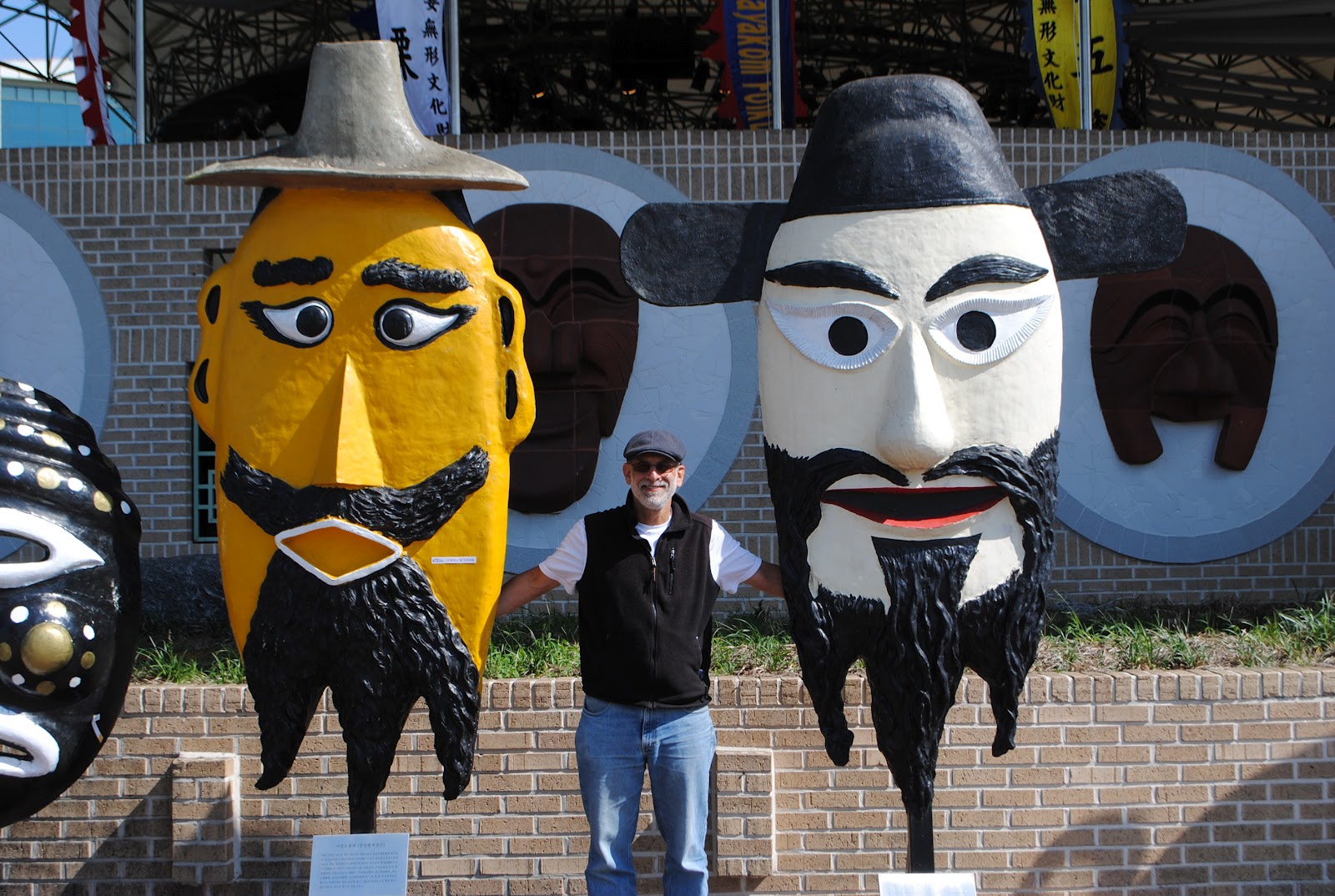
Gifted recently with a few days off for the Korean thanksgiving holiday, Chuseok, a friend and I headed to Andong to attend Korea's famed Mask Festival. The festival itself and the city's culinary specialties of spicy chicken, grilled mackerel and rice wine (soju), all lived up to the lofty tourist hype.


Masks symbolizing the Andong Mask Festival
Festival "attendees" with beards and hats in common
When the night grew still, when the voices quieted and the hum of the cars and buses ebbed, it was time to find our way to the Korean inn where I had made reservations. Man Hyu Guest House was 20 minutes out of town, in the foothills northwest of Andong, near the Bong Jung Buddhist Temple. The innkeeper welcomed us warmly in the Korean tradition. We were enveloped by tranquility and comfort. I fell asleep listening to the song of water cascading down a rocky stream just outside my room. 
At our inn: A comforting breakfast of rice porridge
The guest house was literally at the end of the line - in this case, bus #51. I recall the traveler's credo I strive to abide by: Have trust. Ride with the breeze. Live the life you please. No problem exists, even if the sun doesn't shine--when you're going to the end of the line.


Saturday, September 22, 2012

You Can Go Home Again


If taxes and things like the new airline fees we are all paying seem unfair, what do you call the passing of time? --that which seemingly prevents us from ever being able to return home again—as Thomas Wolfe’s book of the same name famously put it.

But is it true that we can’t go home? Yesterday, I returned to the neighborhood I once lived in as a Peace Corps trainee in Daegu, Korea. In the winter of 1973 it was a cold and dusty section of town, bordered by a large park (Dal Seong Park) that brought dignity and some open space to a dense community which once featured an ancient fortress and whose history dates back to the Bronze Age.
Dal Seong Park (spring 1975). Author seated on right.

Today it is no less a hard scrabble place. Mr. Lee, who owns a pastry stall in the neighborhood, told me the nearby alleys still feature old, dirty Korean inns where you can get “s.” “S?” I asked quizzically. “Sex,” he answered with a sheepish grin.  I wasn’t looking for sex but I was searching for something else—an old Korean bathhouse I had frequented for several months during that winter of 1973. In those days, hardly any Korean homes or inns had baths or showers. Every so often people would go to a public bath and share huge scalding hot tubs with dozens of people. I was returning to see what had happened to that bathhouse—an institution which has literally disappeared in Korea along with the less endearing "bucket brigade" of men who used to go door-to-door removing sewage with large sturdy brown buckets dangling from wooden polls that ran across their backs.
Honey Bucket Men (Daegu circa 1974)
I stopped and questioned two old women who were squatting in front of a store. I pointed across the street and in halting Korean asked if the building was a bathhouse about 30 years ago. One of the old women waved me on and the other laughed—they obviously thought I was crazy. But I soon found Mr. Lee behind his counter and asked if he spoke any English. He smiled and said “Yes.”  “Would you know,” I asked, “if that building used to be a bathhouse?” “Sure,” he said. “look at the top, it still has that large vent that was always on the roof of bathhouses.” Looking up, I noticed a barely visible red insignia depicting steam coming out of a circle that was synonymous with bathhouses.

I was pleased. The inn I once stayed at was now a lifeless parking garage but I had at least found my way home. I reminded myself of a traditional Korean folk music concert I attended just a few months ago. Sitting alone in the back row I suddenly started to cry. The familiar music had found an emotional vein sending years of sentiment and stored memories gushing uncontrollably.

One can indeed go home. I was there. But there is an emotional fee to pay for the time and memories that have escaped from the bottle--those things that naively once seemed so everlasting.

Sunday, September 16, 2012

The Way of Rice

In malls throughout the United States I have seen vendors selling grains of rice with microscopic words--even entire poems--novelly inscribed on a single grain of rice. It's an ironic endeavor given the pervasive and timeless role that rice has played in Asian societies. Rice is a central part of the culture here in Korea and has been for thousands of years influencing music, dance, how respect is paid to ancestors, even providing straw roofing for homes.

Rice is literally served with every Korean meal. It is so integral to Korean society that there are perhaps two dozen words for rice--each describing a specific state, stage or nuance. For example, mo is a rice seedling, sal is husked rice, pap is cooked rice, beo is rice grain, nwi is unhusked rice in husked rice--you get the idea.

"Pap" cooked rice, in Korean

My earliest and rather fond dealings with rice were with a black man I met as a kid. Perhaps the most comforting face in the A&P supermarket--where my mom shopped--was that of Uncle Ben. His iconic image graced the package of what was certainly one of America's most popular food products of the 1950's and 60's, Uncle Ben's rice.
My first experience with rice was with this gentleman
The U.S. was, and still remains, a leader in rice production--ranking 11th worldwide. But Korea, roughly the size of the state of Indiana, is 12th, producing 7.4 million tons of rice annually. China ranks first with a harvest of nearly 200 million tons. (data courtesy of Dr. Yoo Man, V.P. of ICID)

Rice paddies found throughout Korea paint the country in rich, undulating shades of green. Visible from high-speed trains, car windows or along local streets and country lanes, rice paddy fields ("non" as they are known in Korea) grace the space between mountains, rivers, cities and villages. In a sense, they fill the spiritual space, the soul of place here.

It's hard to over-estimate what rice has meant in the history of society here, and frankly, what it continues to mean in a Korean's life. Indeed, the words of a single grain of rice have centuries of stories to tell.

Rice paddies on the campus of Yeungnam University